
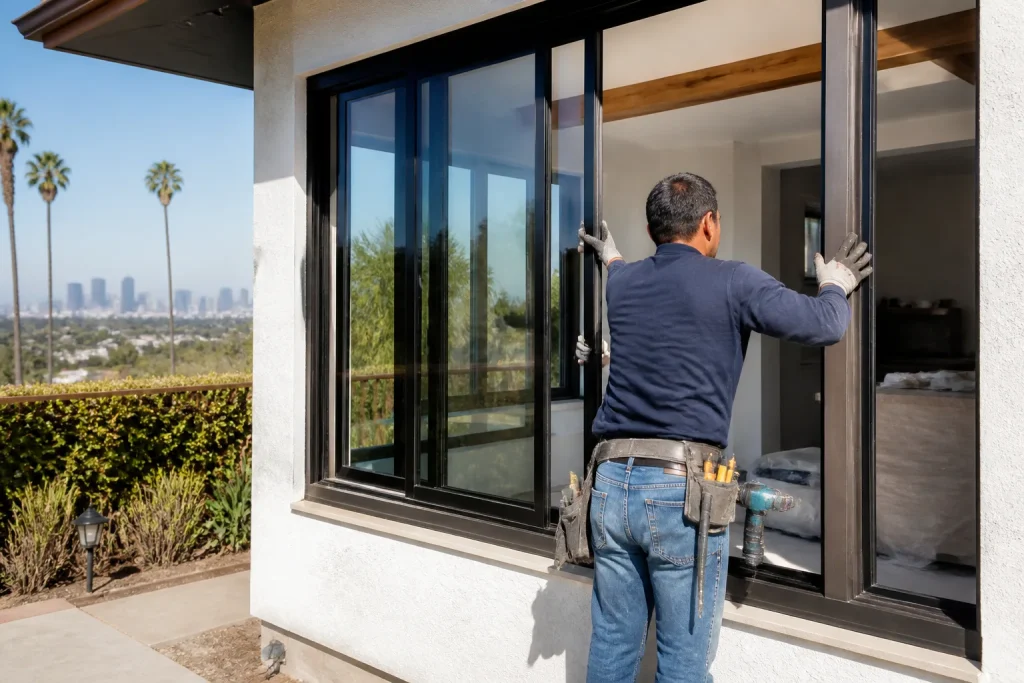
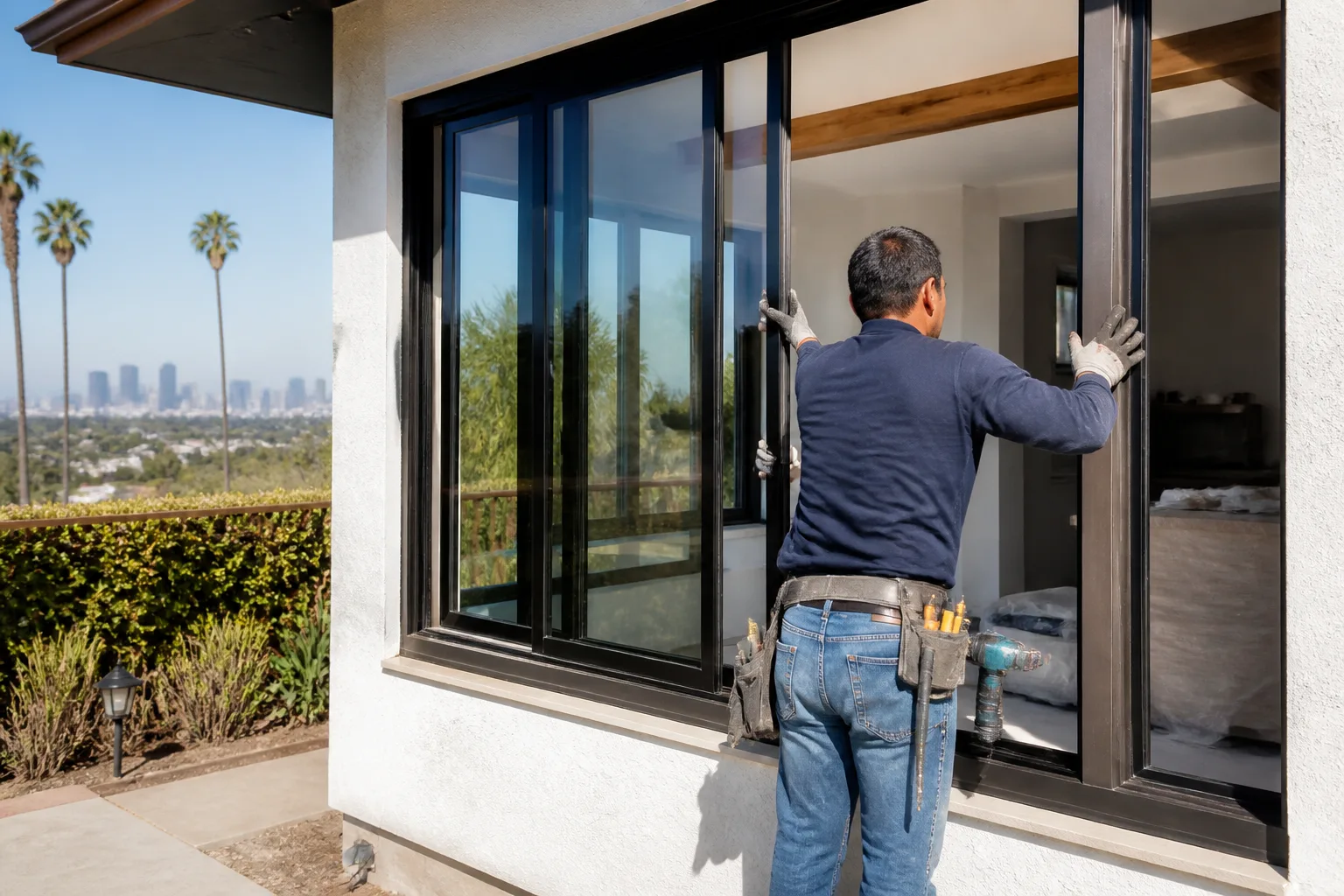
ES Windows Window Installation in Los Angeles: A Homeowner’s Guide
ES Windows installation in Los Angeles typically costs $850 to $1,400 per opening for a standard retrofit, and $1,300 to $2,100 per opening for a full-frame replacement in stucco construction. The single most common reason these units fail has nothing to do with the window itself: installers skip the published flashing sequence and treat the rough opening like a generic vinyl rough-in.
ES Windows ships every unit with an installation manual that specifies flange nail spacing to the inch. Most LA crews never open it. We do, because the manual is where the warranty lives. If you’d rather not spend your weekend reading flashing diagrams, call (509) 265-6387 and we’ll walk the site with you.
What Makes ES Windows Different From Standard Vinyl Units
ES Windows are fabricated to tighter dimensional tolerances than the commodity vinyl frames you’ll find at big-box supply yards serving Los Angeles. The frame extrusions are milled for a specific rough opening clearance: the published spec calls for 1/4 inch on each side, not the 3/8 to 1/2 inch that standard vinyl windows allow. In older LA stucco construction, especially in neighborhoods like Mar Vista, Westchester, and Valley Glen, the existing rough opening is almost never square to that tolerance. You can’t force a precision unit into a trapezoid and expect the weep system to drain.
The key differences homeowners should understand before any install:
- Rough opening clearance: ES spec is 1/4 inch per side. Standard vinyl tolerances run looser, and crews accustomed to loose tolerances will shim ES units incorrectly.
- Flange nail spacing: ES documentation specifies fastener placement every 4 inches on the head flange and every 6 inches on jambs, and the sequence matters. Few installers in Los Angeles can cite those numbers from memory.
- Glazing bead orientation: ES frames use a specific bead profile. If the bead is seated with the wrong pressure or in the wrong direction, the insulated glass unit shifts over time, and you’ll see condensation between the panes by year two.
- Sill pan requirement: ES install docs require a rigid sill pan with end dams at the rough opening before the unit is set. On stucco retrofits, crews often skip the pan entirely and rely on caulk, which fails in LA’s wet winters.
We’ve pulled ES units out of homes in Los Angeles window replacement jobs where the previous installer used spray foam to fill a 5/8-inch gap because the rough opening was cut oversize. The window was fine. The install wasn’t. That’s the distinction this guide exists to teach.
How Title 24 Affects ES Window Documentation in Los Angeles
Los Angeles enforces Title 24 energy compliance on every permitted window project, and ES Windows are available in performance packages that meet or exceed the current prescriptive requirements. But here’s what most homeowners don’t hear until close-out: the permit documentation must match the unit that actually went into the wall. If the installer substitutes a different U-factor or SHGC than what’s listed on the signed plans, the final inspection can fail, and the correction costs time and money.
ES units are labeled at the factory with the exact U-factor, SHGC, and air infiltration rating for that specific configuration. Before any installation begins in Los Angeles, read that label and compare it against your permit set. The label is a sticker on the head of the frame and a printed card in the hardware packet. If the numbers don’t match your approved Title 24 documentation, stop the install. Do not let the crew peel the label and start cutting flashing.
What to verify on the ES unit label before installation:
- U-factor: Lower is better. Los Angeles climate zones typically require 0.30 or lower on the prescriptive path for replacement windows, depending on the zone.
- SHGC (solar heat gain coefficient): This matters more than U-factor in LA. South and west-facing walls need lower SHGC values to keep cooling loads down. ES offers glass packages tuned for orientation.
- Air infiltration rating: ES publishes these per unit, not per product line. Confirm the number matches the spec sheet you were quoted.
- Frame material code: ES window frames are thermally broken aluminum. The label will show the alloy and thermal break spec.
If you’re not sure how to read the label, that’s a legitimate reason to call a pro. We photograph every ES unit label before installation as part of the measured survey, and the photo stays in the job file. That’s not a courtesy; it’s how documented proof works.
The Flashing Sequence: What ES Recommends vs. What LA Crews Actually Do
ES Windows’ installation manual specifies a full four-layer flashing sequence for stucco exteriors: a sill pan with end dams at the bottom, jamb flashing that laps over the sill pan, head flashing that laps over the jamb flashing, and then a final drainage layer that directs water from the face of the head flashing down and out at the bottom. The sequence is directional. Water has to exit at the bottom, not at the sides, and the lap directions are what make that happen.
The most common LA shortcut is relying on the existing housewrap as a de facto water-resistive barrier and caulking the fin. We see this on stucco homes from the 1960s and 1970s, especially in the San Fernando Valley, where the original felt or kraft paper behind the stucco has degraded to the point that it sheds water into the wall cavity instead of draining it. ES windows installed over degraded wrap leak exactly like you’d expect: you’ll see water stains inside the wall before you see them on the drywall, which means the damage is already done by the time you notice it.
The correct sequence, in order:
- Sill pan with end dams: rigid pan, not flexible tape, with turned-up ends that direct water out at the face of the wall.
- Jamb flashing: applied to the sides of the rough opening, lapped over the sill pan so water flows down, not behind the pan.
- Set the unit: ES frames are set into the pan and fastened through the fin at the manufacturer’s specified spacing.
- Head flashing: lapped over the jamb flashing, never the other way around.
- Final drainage layer: the face of the head flashing is integrated with the weather-resistive barrier above the window so water running down the wall is directed out over the head flashing, not behind it.
We pulled a failed ES unit out of a garage conversion over in Atwater Village last month where the previous installer had nailed the head flashing flat against the stucco with no drainage lap. The window was physically in the opening and mechanically locked; it just leaked from the day it was installed. The homeowner didn’t find out until the first winter rain, and by then the bottom plate was soft enough to push a screwdriver through. That’s a rough lesson, and it’s fully avoidable.
Reading an ES Window Label Before Installation: What to Check
The ES unit label uses a standard format: factory ID, order number, unit dimensions, glass package code, U-factor, SHGC, air infiltration, and the manufacturing date. The glass package code is the critical piece; it tells you exactly which insulated glass unit went into the frame. Los Angeles homeowners should demand to see and photograph this label before the unit goes into the rough opening, because once the wall is closed over, you can’t verify it without disassembly.
How to interpret the important lines:
- ORDER NO: Match it to your purchase order. If the numbers don’t match, the wrong unit was delivered to your site in Los Angeles.
- GLASS PKG: This is the key spec. ES codes label the glass configuration, and the code determines the U-factor and SHGC. If the package doesn’t match what you approved, the unit doesn’t perform as quoted.
- U-FACTOR / SHGC: Confirm against the permit set, as covered above. Write it down. Take a photo.
- MFG DATE: ES units carry a manufacturing date. If you’re receiving a unit that’s been sitting in a warehouse for more than a season, check the glazing bead and the seal condition before install.
- OPERATING TYPE: Fixed, casement, awning, slider. Confirm the hardware is present and matches the label before the crew starts.
We treat label verification as part of the installation scope on every ES job. Before we set the first unit, you’ll have a photo of each label attached to the measured survey document. If something doesn’t match, we stop and sort it out, because she’s the one who signs the invoice, and we don’t want her signing for a unit that isn’t what was sold.
What a Post-Installation Photo Record Should Capture for an ES Window
You’re entitled to documented proof of what’s behind your stucco, and that proof is photographic. A proper ES Window photo record shows the work before it’s covered by the finished wall cladding. If your installer offers “before and after” shots of the window from the street, that’s a brochure, not a record. The record is taken at the rough opening, mid-install.
Three photos, minimum, that every Los Angeles ES window installation should produce:
- Sill pan photo: The rigid pan with end dams, taken before the unit is set. This proves the pan is in place and the end dams are turned up correctly.
- Nail fin photo: The unit’s flange after fastening, showing the fastener spacing around the full perimeter. This proves the fastening pattern meets the published spec, and nobody freehanded it with a nail gun at random distances.
- Glazing bead photo: The interior frame edge after the bead is seated, showing the bead profile seated consistently around all four sides. This proves the insulated glass unit is locked in correctly, and it’s your defense against a future condensation claim.
Those three photos belong in the project file. If the installer won’t produce them, that’s an answer. That’s a contractor telling you they didn’t do it right and they know it. We include a documented photo record on every ES Window installation, and it travels with the written warranty. That’s Haven Clause 4: Evidence on every job.
For homeowners researching window work in Los Angeles, here’s the difference in how we operate: Sightline’s window installation service in Los Angeles starts with a measured survey you keep, and the written quote is built from that survey. Our door installation service in Los Angeles follows the same protocol. Every job ends with the photo record and a written warranty.
When to Call a Pro
Installing an ES Window is not a weekend DIY project, and it’s not a job for a handyperson with a caulk gun. The unit is a precision product; the rough opening in an older Los Angeles stucco home is not precision; and the interface between the two is where failures happen. If any of these conditions apply to your project, call a pro:
- Your rough opening is out of square by more than 1/4 inch in either direction, and you don’t have the tools or intent to correct it properly.
- The stucco around the existing window is cracked, stained, or showing signs of past water intrusion; the wall under the finish is the part that needs the work.
- Your permit requires Title 24 documentation, and you’re not sure the unit labels will match the plans.
- You don’t have the time or appetite to photograph the sill pan, nail fin, and glazing bead before the wall closes up.
All of our technicians are background-checked, uniformed, and identified by license number before arrival, which the Haven Standard’s Verified Crews clause puts in writing before we ever show up at your door.
The Bottom Line
ES Windows are built to perform if they’re installed to the published spec, and most Los Angeles installation failures happen because the installer skipped the spec. The rough opening clearance is tighter than standard vinyl; the flashing sequence on stucco is directional and non-negotiable; the Title 24 documentation has to match the unit label; and the photo record is your proof that all of it happened. If you’ve read this far, you know more about ES installation than the average contractor bidding your job in Los Angeles does.
If you’re in Los Angeles and need help with ES windows, Sightline Windows & Doors home is the place to start. We offer free estimates, and the measured survey and written quote are the same document. Call (509) 265-6387 and tell us what you read in this guide; we’ll pick it up from there.
Frequently Asked Questions
ES window installation in Los Angeles runs $850 to $1,400 per opening for a standard retrofit and $1,300 to $2,100 per opening for full-frame replacement in stucco construction. The total depends on the rough opening condition, Title 24 compliance work, and whether the existing flashing needs correction. Call (509) 265-6387 for a written quote specific to your openings.
Yes. ES Windows require a 1/4-inch rough opening clearance per side, a rigid sill pan with end dams, a four-layer directional flashing sequence, and fastener spacing every 4 inches on the head flange and 6 inches on the jambs. Skipping any of these steps voids the manufacturer’s warranty and leads to leaks in Los Angeles winters.
A retrofit installs the new ES unit inside the existing frame and costs less in Los Angeles, but it requires the existing frame to be sound and the rough opening to meet clearance. Full-frame removes the old frame down to the studs and is necessary when the existing frame is rotted, the opening is out of square, or Title 24 requires it. Full-frame is the only option when the existing flashing has failed.
Check the factory label on the ES window before installation. The order number, glass package code, U-factor, and SHGC on the label must match your purchase order and permit set. Photograph the label, and require the installer to include it in the job file. Call (509) 265-6387 if you need help reading a label on an ES unit in Los Angeles.
Written by Sonia Raman, Owner at Sightline Windows & Doors, serving Los Angeles since 2012.
Need Windows & Doors Help?
Call Sightline Windows & Doors - licensed & insured, here with fast after-hours help in Miami.
(509) 265-6387